The Quick Answer: AI Agents or Traditional Automation in 2026?
Choose traditional automation (RPA) for stable, high-volume, rule-based processes with no ambiguity. Invoice entry, form transfers, and fixed reconciliations all fit this lane.
Choose AI Agents when judgment, exceptions, unstructured data, or multi-system reasoning are involved. Customer disputes, underwriting, and dynamic supply chain rerouting are classic examples.
For most businesses, the real 2026 answer is not either/or. It is a hybrid stack: RPA executes the fixed steps, AI Agents handle the reasoning around them, and new automation budgets are shifting almost entirely toward agents.
Two Technologies, Two Philosophies
Before comparing features, understand the philosophical split behind them. It explains every practical difference that follows.
Traditional automation (RPA, or Robotic Process Automation) is deterministic. A bot is scripted to click a specific button and copy specific data into a specific system, the same way every time.
It has no understanding of why it does what it does. Change the interface it was scripted against, and it breaks instantly.
AI Agents are probabilistic and reasoning driven. Built on large language models with tool calling and memory, an agent is given a goal, not a script.
It decides its own sequence of steps and adapts when something unexpected happens. It can handle a messy email, a scanned invoice, or a garbled voice note, none of which were explicitly programmed for.
The industry already treats 2026 as an inflection point. RPA follows rigid scripts; AI agents plan, reason, and adapt.
Organisations that treat this as evolution, not replacement, are automating more effectively than those bolting AI onto old RPA thinking.
Traditional Automation (RPA) vs. AI Agents: The 2026 Comparison
| Dimension | Traditional Automation (RPA) | AI Agents (2026) |
|---|---|---|
| Core logic | Fixed, rule-based scripts | Reasoning + planning via LLMs |
| Handles unstructured data? | No, needs clean, structured inputs | Yes: emails, PDFs, voice, images |
| Exception handling | Escalates to a human immediately | Resolves autonomously, escalates only true edge cases |
| Adapts to UI/process change? | No, breaks when interfaces change | Yes, reasons around change contextually |
| Setup speed | Fast for narrow, fixed tasks | Fast for broad goals; more design effort for guardrails |
| Year-one cost (typical enterprise deployment) | ~$228,000 | ~$77,000 |
| Annual maintenance (% of build cost) | 20–30% | 10–15% |
| 3-year ROI (Forrester, AI agent deployments) | Lower, plateaus | ~210% ROI, payback under 6 months |
| % of business processes automatable | ~20–30% (RPA alone) | 60–80% in well-executed deployments |
| 2026 market size | ~$27–30 billion | ~$10.9 billion, growing 45%+ CAGR |
| Best for | Invoice entry, data migration, fixed reconciliations | Customer support, underwriting, dynamic supply chain, dispute resolution |
| Failure mode | Silent breakage on any deviation | Token-spend runaway, hallucinated actions if under-governed |
The one sentence that matters most: RPA automates tasks. AI agents automate decisions and outcomes.
Why This Comparison Is Suddenly Urgent in 2026
This is not an abstract technology debate. It is a budget reallocation happening right now.
A few numbers make the shift concrete. The AI agent market is projected to cross $10.9 billion in 2026, growing at over 45% CAGR, while RPA-only spend growth has slowed well below earlier industry projections.
84% of enterprises say they plan to increase AI agent investment in 2026. In one large executive survey, every single organisation reported expanding agentic AI initiatives in some form.
Enterprises that transitioned from pure RPA to AI-agent-based automation report a 40% reduction in total cost of ownership within 24 months. The maintenance burden of RPA, constant re-scripting every time a vendor changes a UI, is traditional automation’s single biggest hidden cost.
Gartner has noted that roughly 90% of RPA vendors have already embedded generative AI into their own platforms. Even the traditional automation industry concedes that pure rule-based bots cannot meet 2026 enterprise demands alone.
None of this means RPA is obsolete. It means the default choice for new automation projects has flipped, and businesses still buying pure, rigid RPA bots for anything beyond narrow structured tasks are buying yesterday’s answer to today’s problem.
The Decision Framework: Which One Does Your Business Actually Need?

Ask three questions about the process you are trying to automate.
Is the input structured and predictable?
Same form, same fields, same system, every time.
Are there frequent exceptions that currently require human judgment?
And does the process span multiple systems that do not talk to each other?
If Q1 is yes and the others are no, stick with RPA. It is cheaper, faster to deploy, and perfectly reliable for that narrow lane.
If either of the other questions is yes, you need an AI agent. The value sits entirely in the judgment calls and cross-system reasoning RPA cannot perform.
If you already have RPA bots doing part of the job well, do not rip them out. The winning 2026 pattern is called “Agentic RPA.”
Keep the stable, high-volume bots running for the deterministic steps. Layer an AI agent on top as the orchestrator, calling those bots as tools, the same way it would call an API.
The Real Cost Picture: Why the Economics Have Flipped
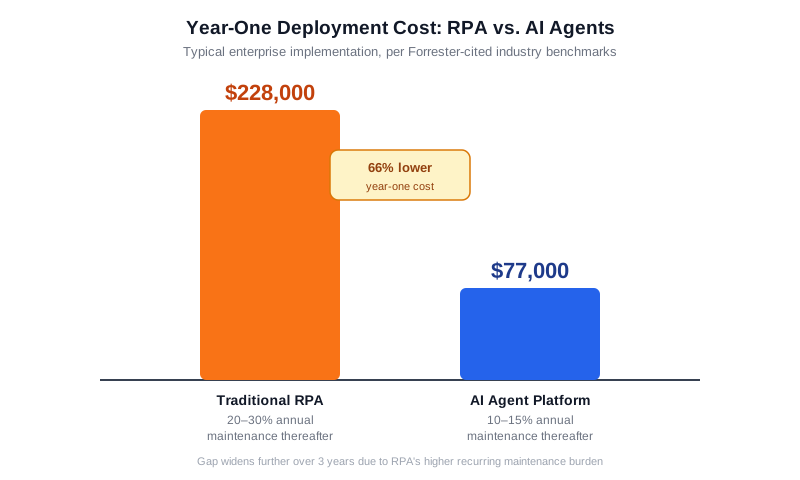
The upfront cost gap is real. But the bigger story is what happens after year one.
RPA’s maintenance burden compounds. Every vendor UI update and every layout change requires a developer to go back and re-script the bot.
That is why RPA maintenance typically runs 20 to 30% of the original build cost every single year, indefinitely. AI agents need far less of this rework, typically 10 to 15% annually, because they reason contextually instead of following fixed coordinates.
Compounded over three years, this is why Forrester’s research on AI agent deployments found organisations achieving roughly 210% ROI, with payback periods under six months. Pure RPA rarely matches this once its maintenance tail is factored in.
The catch: these returns assume disciplined deployment. A widely cited 2026 failure pattern, sometimes called “agent washing,” is vendors rebranding old RPA or chatbot products as agentic AI without adding real reasoning or autonomy.
Roughly a quarter of enterprises deploying AI agents see the returns. The other three-quarters typically fail from weak governance and unclear ownership, not from the technology itself.
Where This Plays Out for Indian Businesses Specifically
The RPA-vs-agent decision has a distinctly Indian texture, for reasons covered in our companion piece on Agentic AI for Indian Businesses: thin margins, fragmented regional operations, and 22-language customer bases.
An earlier IDC APJ Automation Survey found that 84% of Indian organisations already consider end-to-end automation a must-have for competitive survival. Yet the same survey found 90% still lacked an enterprise-wide RPA programme.
That gap is exactly where AI agents have an advantage RPA never had. Agents reason over context rather than fixed screen coordinates, so they can orchestrate across disconnected departmental silos without a developer hard-coding every integration point.
This lines up with what Indian enterprise leaders are already telling researchers. Separate EY India research found that 24% of Indian C-suite leaders have already deployed agentic AI into production, with most of the remainder actively piloting it.
That is a faster, more decisive shift than the RPA adoption curve India saw a decade ago, when enterprise-wide rollouts often stalled for years inside IT approval cycles.
Risks of Getting the Choice Wrong
Over-investing in new RPA in 2026 means building on a cost structure that is already becoming uncompetitive. You will be re-scripting bots against every UI change while competitors’ agents adapt automatically.
Under-governing AI agents creates a different risk. Unlike a bot that fails loudly and stops, a poorly governed agent can take a wrong action confidently: approving a refund it should not, misrouting a shipment, or burning through API costs in a retry loop nobody is watching.
This is precisely why phased rollout matters more for agents than it ever did for RPA. Internal search, then human-in-the-loop approval, then limited autonomy: that sequence keeps the blast radius small.
Ignoring the hybrid option is the most common strategic mistake. Very few enterprises need to choose one technology exclusively.
The businesses seeing the strongest 2026 results run RPA and AI agents side by side. RPA handles the boring, stable, high-volume steps; agents handle everything that requires judgment.
A Practical Migration Path (Not a Rip-and-Replace)
- Audit your existing RPA fleet. Classify every bot as “stable and cheap to maintain” or “high-maintenance and constantly breaking.” The high-maintenance ones are your first migration candidates.
- Redirect all new automation requests to agentic platforms. Stop building new pure-RPA bots for anything involving judgment, unstructured data, or cross-system decisions.
- Retire the most fragile bots first. The savings from replacing your worst-performing RPA bots typically fund the rest of the transition.
- Keep stable bots running as agent-callable tools. A working RPA bot does not need to disappear; it becomes one function an AI agent can call, the same way it would call a UPI or ONDC API.
Frequently Asked Questions
What’s the real difference between an AI agent and just a smarter chatbot?
This trips up a lot of people, understandably, since both use similar underlying AI models. The honest answer is that a chatbot’s job ends the moment it finishes typing a reply.
An agent’s job ends when the actual task in the real world is done. A chatbot can tell a customer, “your refund has been approved.”
An agent goes further. It actually processes that refund, updates the order record, and confirms it, with no human needed to close the loop.
If it only talks, it is a chatbot. If it acts and checks its own work, it is an agent.
How do I figure out if my company should replace our existing RPA bots or just add AI agents on top?
Honestly, in almost every case we have seen, “add on top” beats “rip and replace.” If your RPA bots are quietly doing their job and nobody has touched their code in months, they are not the problem.
The smarter move is asking where your team gets stuck making manual judgment calls the bots cannot handle. Build an agent specifically for that gap.
Over time, as you notice which RPA bots keep breaking and eating up developer hours, you will naturally start retiring those. That is a gradual, cost-driven decision, not a one-time migration project.
Is it too risky to let an AI agent make decisions that used to require human approval, especially for anything involving money?
It is a fair worry, and the answer is: risky only if you skip the guardrails. That is exactly what separates the businesses getting real ROI from the ones getting burned.
Nobody serious hands an agent unlimited authority on day one. That is not how any successful 2026 rollout has actually gone.
The pattern that works is starting small. Let the agent draft the decision, have a human approve it for a few months, then gradually raise its autonomy only for the lowest-risk, highest-confidence scenarios, say refunds under a fixed rupee threshold.
Treat it exactly like training a new employee: real responsibility, earned gradually, not unlimited trust from day one.
The Bottom Line
The traditional-automation-vs-AI-agents debate is really a question about where your business still has ambiguity. If the process is a straight line, RPA remains the cheaper, more reliable choice.
If the process has forks, exceptions, and judgment calls, which describes most of what actually costs businesses money and customer goodwill, the direction is clear. Build the reasoning layer with AI agents, and let your existing automation do what it already does well underneath it.

Talk to our automation and AI experts

Pooja Upadhyay
Director Of People Operations & Client Relations


